
Chemical waste
Special waste are made of conditioned chemical waste (acid, mixed hydrocarbons, oils, light bulbs, neons, etc…).
Efficient waste management means ensuring waste flows are directed into the appropriate disposal processes.
Special wastes are subject to a disposal procedure defined by the Swiss ordinance on the movement of waste, the Ordonnance sur les mouvements de déchets (OMoD). For more information on waste movement please consult the relevant website: https://www.veva-online.admin.ch/
Chemical waste must be stored in a suitable receptacle bearing an official label together with the Material Safety Data Sheet (MSDS). To process waste in complete safety we need everyone’s help.
You can find more information on the validity and official designation of packaging on this document (only in French)
Procedure
Special wastes must be disposed of in their original packaging or in hermetic receptacles. ALL RECEPTACLES MUST BE LABELLED to allow identification of the substance and the principal hazards.
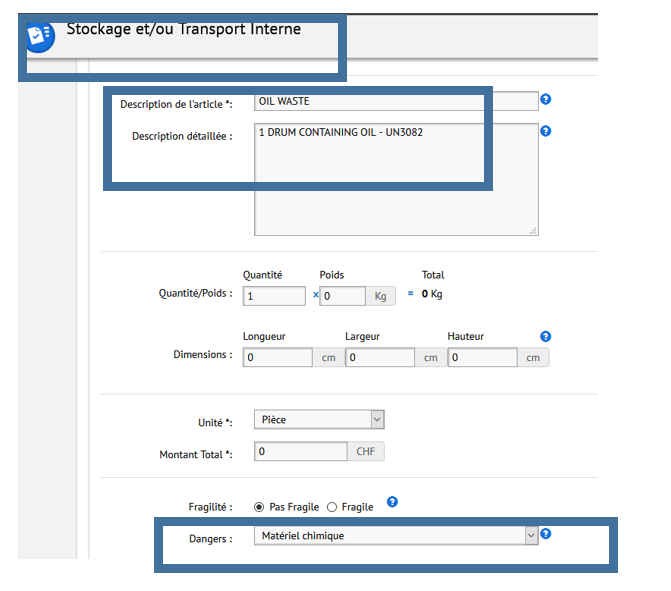
- A “Transport Request” must be completed.
- The transport request must include the name of the substance and the UN number. Please also attach the MSDS.
- All chemical wastes are to be delivered at building 262.
- Send the transport request.
Details
| Asbestos, fibrocement | Please submit an internal transport request via EDH to building 312 |
|---|---|
| Capacitors | Please consult this document (only in French) |
| Filters for self-rescue masks | Please consult this document (only in French) |
| Laboratory waste | Please submit an internal transport request via EDH to building 262. Each bottle or packaging must be closed, clean and labeled with the product name and UN numberIf you have several categories, an excel sheet must be attached to the internal transport request mentioning: product name, UN code and quantity estimation per bottle/packagingSorted by hazard category |
| Mask, combinations and rags | Please submit an internal transport request via EDH to building 262.Only solid homologated packaging can be usedMasks, combinations and rags soiled with the same chemical can be loaded in the same packagingMasks, combinations and rags soiled with different chemicals must be loaded in different packagings |
| Neons and all type of lamps | Please submit an internal transport request via EDH to building 133.FLUORESCENT TUBES 50 TO 150 CM LONG: please consult this document (only in French)COMPACT FLUORESCENT BULBS LESS THAN 50 CM IN LENGTH: please consult this document (only in French) |
| Nickel/Cadmium batteries | Please submit an internal transport request via EDH to building 133 if: Batteries are in good conditionProtected from short-circuitsBatteries must be correctly placed in non-conductive pacakaging (no risk of leaing, falling, shock)Lead batteries: please submit an internal transport request via EDH to building 133.Used batteries no subject to ADR: please consult this document (only in French) |
| Small lithium batteries / others | As soon as the dedicated containers placed in your building are full, please send a “Small batteries collection” request via Service Now.Only batteries in good conditionLithium batteries weighing more than 50 grams must be delivered directly to building 133Damaged lithium batteries must handled separately:Put your damaged lithium batteries in a plastic bagIssue a ticket via the Service Portal that a damaged battery will be brought to building 133Wait to get approvalBring the damaged battery to building 133 |
| Solid waste contaminated with lead | Please consult this document (only in French) |
| Waste containing mercury | Please consult this document (only in French) |
| Waste oil | Please consult this document (only in French) |